HSG47 utility colour code chart for UK construction
The HSE's HSG47 guidance sets the utility colour codes used on every UK building site. Here's the full chart, the quick rules, and the bits that catch crews out.
By GroundPin team, GroundPin
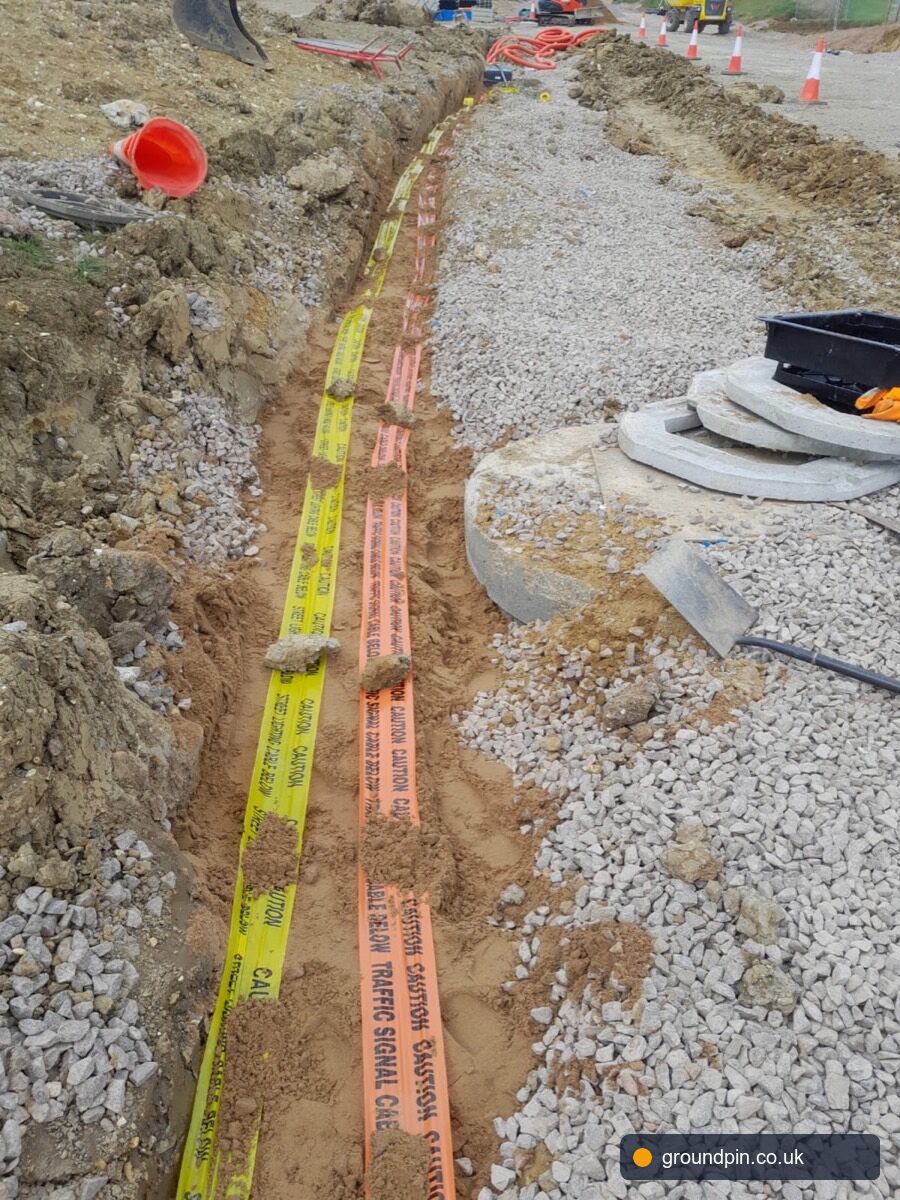
HSG47 is the bit of HSE guidance that tells you what colour to spray on the tarmac when you've found a cable. Every CAT survey, mark-out crew and utility drawing in the country works to it. If you've been on site more than a day you already know red means electric. The full chart is longer than most folk realise, and a couple of the lesser-known colours come up on highways and heat-network jobs often enough to catch people out.
Here's the lot, pulled together. Print it, tape it to the cabin door, whatever works. The full document is a free download from hse.gov.uk and we've linked it at the bottom.
The short version
Nine colours in the current third edition of HSG47 (last revised 2014, still in force at time of writing).
| Colour | Service | Typical use |
|---|---|---|
| Red | Electric | LV and HV, DNO feeds, street lighting supplies |
| Blue | Water | Potable mains and service pipes |
| Yellow | Gas | Low and medium pressure mains |
| Green | Telecoms / data | BT Openreach, Virgin, comms on a site network |
| Orange | Fibre (non-telecoms) | CCTV fibre, control-system cables, traffic signalling |
| Brown | Sewage / drainage | Foul and surface water |
| Purple | Reclaimed water | Industrial or grey-water mains |
| Black | Oil | Fuel lines, aviation pipework on MOD estates |
| White / grey | Unknown | Something there, can't confirm what yet |
Three things that trip people up.
Street lighting doesn't get its own colour in HSG47. Most councils still take the feed from the local DNO, so lighting stacks run red with the rest of the electrics. Highways schemes run directly by National Highways sometimes ask for separate tagging. Read the client's drawings before you start spraying.
Telecoms green covers most of what carries data, but not everything. A fibre run feeding a building's BMS, or a tray serving variable-message signs on a motorway, usually goes orange. The split is about where the fibre sits in the ground. Telecoms fibre sits in telecoms duct. Everything else sits in the highway and picks up orange.
White is for "we don't know what this is yet". It's not a synonym for "nothing important". If you've uncovered a cable and can't ID it, spray white, log it, and get someone with a CAT and a drawing to come back. Don't guess and don't downgrade it.
Why the colours matter for pin drops
On GroundPin, every pin takes the HSG47 colour for its utility type. Blue for water, yellow for gas, green for telecoms. If a site manager sees a cluster of blue pins round a service bay, they already know they're looking at water before they click into the detail. It's quicker than reading a type label, and it matches the muscle memory a crew already has.
It's also why we didn't invent a new palette. Every construction professional in the UK already has these colours locked in. Making them learn a second legend for a phone app would be a waste of their time.
What HSG47 doesn't cover
HSG47 is specifically about marking out during excavation works. It has nothing to say about:
- Pipework colours inside buildings. That's BS 1710, which uses a different scheme.
- Colours on the utility drawings themselves. Most drawings follow HSG47, but there's no rule.
- Redundant or abandoned services. The informal convention is a colour plus an "X", but it isn't in the HSE document.
HSG47 also doesn't mandate the spray-marking itself. The actual duty under CDM 2015 is that the crew knows what's buried before they start digging. Spray marking is the usual way of discharging that duty. You could do it differently in theory, but nobody does, because everyone else uses spray and a site with two systems is worse than a site with one.
Using the chart on a live site
A3 on the cabin door works. So does tucking a laminated copy into the kitbag. What you don't want is it only living on somebody's phone, because the one morning the phone's flat is the morning someone's guessing whether a yellow pin is gas or something else.
On GroundPin, the web dashboard renders pins in the same palette, and the PDF site report's header mini-map does too. One colour scheme across the app, the dashboard, the report, and your spray cans is the idea.
If your crew regularly tags something HSG47 hasn't reserved a colour for — traffic signal detector loops come up a lot on highways jobs — we ship a GroundPin default colour for it. It's flagged in the app as a GroundPin extension, not an HSG47 one, so nobody mistakes it for standard.
Get the full document
The chart itself is simple. The real win isn't knowing what the colours are. It's everyone on site using the same ones without thinking.